

Data Security Protection Mechanisms
For consumer-facing IoT platforms, access services must be available over the public internet so that devices and apps worldwide can upload data and receive commands. Because the public network environment is complex and security incidents are increasingly common, a major IoT platform breach can have far-reaching consequences. Security is therefore a critical consideration for any IoT platform.
Device-side security primarily covers secure transmission, device authentication, and operation authorization. The following sections describe these three areas.
1) Transmission Security
Smart devices establish encrypted connections to the cloud MQTT load-balancing service by using MQTT over TLS. TLS requires a server certificate. The Ubases IoT cloud platform currently uses a self-signed TLS certificate that is embedded in the IoT communication module in advance. The module uses this certificate for one-way server authentication, verifying that it is connecting to the correct MQTT access service and that the service has not been tampered with. After authentication and symmetric key exchange, all data transmitted over the connection is encrypted automatically. Without the corresponding private key, a network attacker cannot decrypt or alter the transmitted data.
2) Device Authentication
In addition to the device authenticating the MQTT service, the MQTT service must authenticate the device. The Ubases IoT cloud platform uses a “one device, one secret” scheme. Device credentials—including deviceKey, userName, and password—are generated on the platform in advance and flashed to the IoT communication module. The module presents these credentials as its identity when establishing an MQTT connection. If the credentials are valid, the MQTT service accepts the connection and allows data exchange. Otherwise, it rejects and closes the connection.
3) Device Authorization
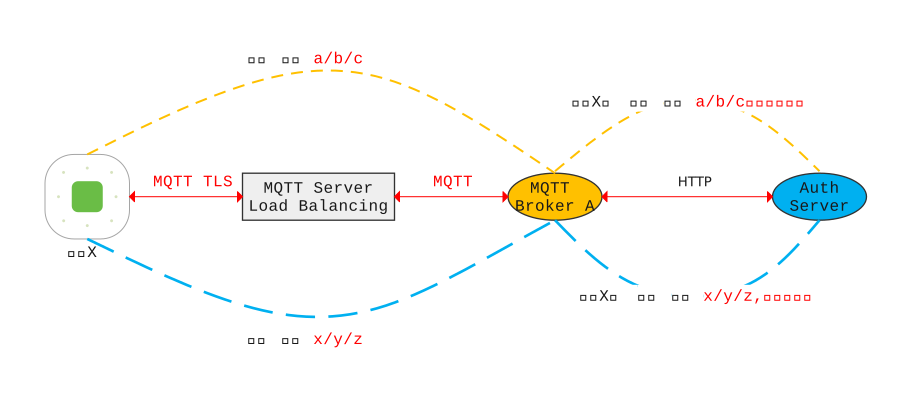
After authentication succeeds, the device establishes a long-lived connection to the MQTT service. MQTT topic permissions prevent devices from publishing unauthorized commands or subscribing to restricted topics. The Ubases IoT cloud platform uses topic ACLs to enforce fine-grained, point-to-point permissions for both apps and devices, specifying which topics each client may publish or subscribe to. When a device publishes a message, the MQTT service calls the authorization service API. The message is accepted only if authorization succeeds. Topic subscriptions follow the same authorization process.