

Business Architecture
The business architecture is divided vertically into product development, app development, device communication integration, marketing, and private deployment, and then horizontally by business domain. Each model has clearly defined responsibilities, making it easy to identify and update the models affected by a business requirement change.
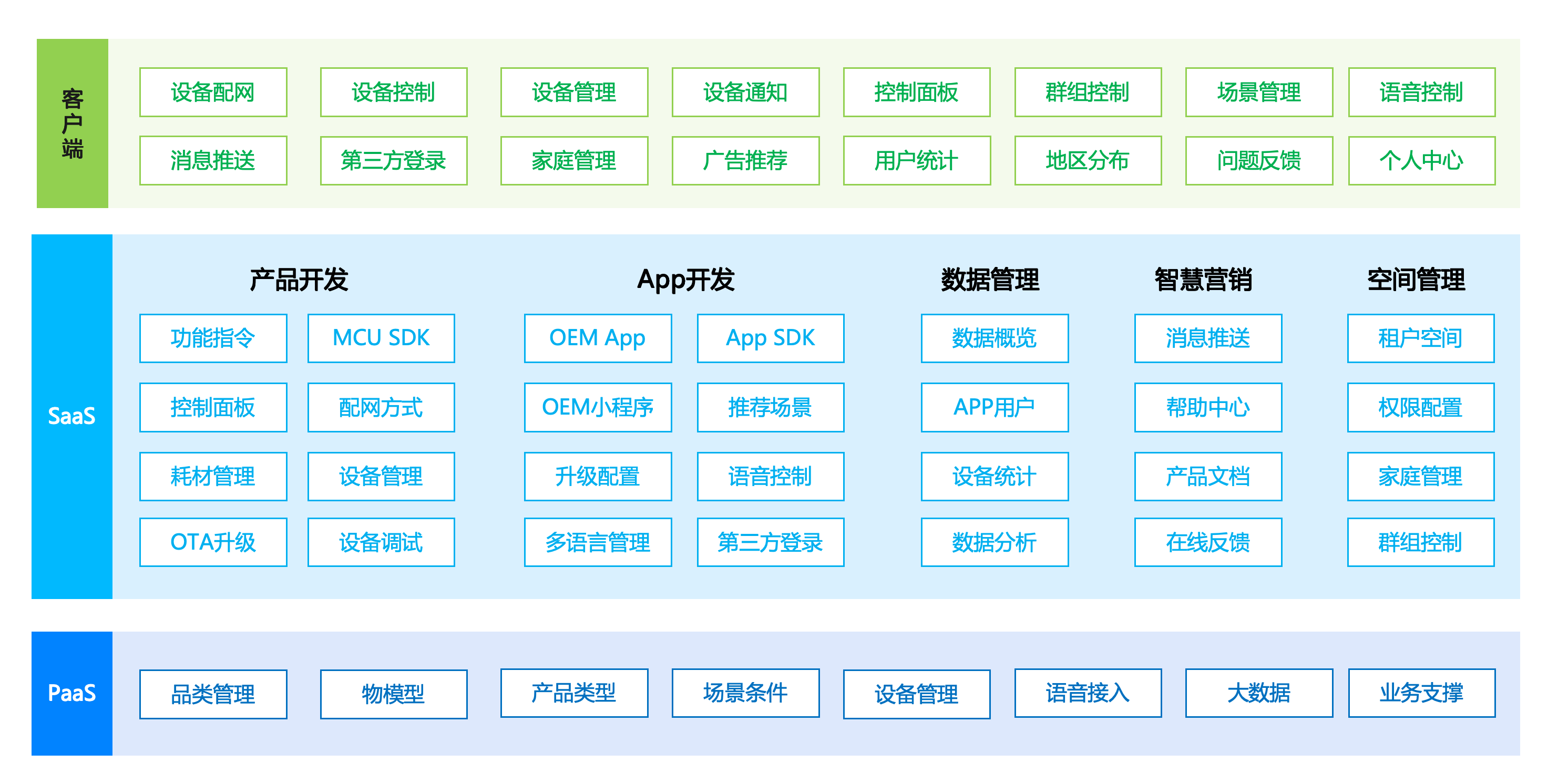
To achieve high extensibility, the application layer is separated from individual business lines. The application layer encapsulates core business capabilities, while each business line implements its own specific requirements. Business lines depend only on the application layer and remain independent of one another, allowing them to evolve freely while preserving overall system stability.
To maximize reuse, common capabilities shared across business lines are extracted into the platform layer after the system models are separated. Examples include notifications, file storage, MQTT communication, device authorization, and user authorization. Services within the platform layer are related: foundational services sit at the bottom of the call chain, while the open platform calls or inherits capabilities from the cloud management platform.
In summary, the Ubases IoT business architecture meets diverse industry needs while continuously pursuing high extensibility and high reusability.