

1. What Is the MCP Protocol?
MCP stands for Model Context Protocol. Simply put, it is a set of "universal translation rules" that lets AI models (large language models such as ChatGPT and Claude) talk smoothly with all kinds of tools, data, and services.
Imagine this: when AI needs to call a calculator, check the weather, or control a smart home device, it needs a standard way to express "what I want to do" — and every tool needs to answer in the same way with "what I did". MCP is the set of rules that defines this way of communicating.
2. Why Do We Need MCP?
Without MCP, the connection between AI models and tools is like two people talking past each other:
- Every tool has its own interface format
- Developers must write different adapter code for different AI models
- Switching to another tool or another model may mean rewriting a large amount of code
With MCP:
- All AI models call tools in the same way
- All tools reply to AI in the same format
- Developers only need to adapt once and can reuse it across different systems
3. What Real Problems Does MCP Solve?
- It lets AI
"call tools": for example, when AI checks the live weather, MCP defines how AI should ask and how the weather service should answer - It lets AI
"remember context": for example, in a multi-turn conversation, AI needs to know what was said earlier — MCP defines the format of that memory - It lets different systems work together: for example, AI first calls a calculator to compute data, then calls a charting tool to draw a graph — MCP makes this flow run smoothly
4. The Core Role of MCP
- Unified language: gives AI and tools a shared "vocabulary" and "grammar rules"
- Simplified connection: developers no longer need to write adapter code for every combination
- Open and compatible: whether it is an OpenAI model, an Anthropic model, or a tool you develop yourself, all can interoperate through MCP
In short, MCP is like the "USB interface" of the AI world. With it, all kinds of AI and tools can be connected as easily as plugging in a USB drive, providing us with more powerful services.
5. The Role of MCP in Embedded Systems
▫️ Removing the "language barrier" between embedded devices and AI models
- Embedded devices are usually highly heterogeneous in hardware (MCUs of different architectures, sensors, actuators), while AI models (especially large language models) typically run in the cloud or on high-performance edge devices.
- Without MCP, interaction between embedded devices and AI models requires a custom communication format for every hardware/model combination (data encoding, command types, return value parsing, etc.), which means high development cost and poor compatibility.
- With MCP, a standardized set of "conversation rules" is provided: embedded devices can describe their own capabilities to AI models in a unified format (for example, "I have a temperature sensor with ±0.5℃ accuracy") and send requests (for example, "help me analyze the temperature trend of the last hour"), and AI models can return results in a standard format as well (for example, a structured trend report)
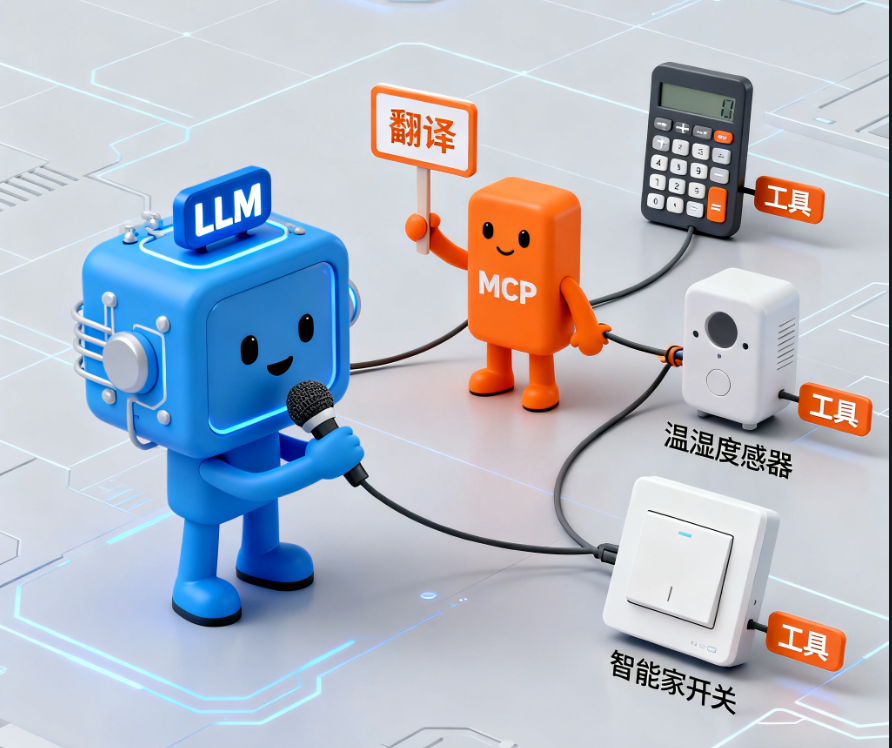
This is like fitting embedded devices and AI models with a "universal translator", greatly reducing adaptation cost.
▫️ Simplifying "feature expansion" of embedded systems
Embedded devices often need to connect to a variety of external tools or services (cloud platforms, local sensor networks, other smart devices) to deliver complex features (smart home control, industrial monitoring, IoT integration).
- In the traditional approach, every new tool requires a dedicated interface (parsing the tool's API format, handling exception cases, etc.), while embedded systems usually have limited resources (compute power, storage) and struggle to carry a large amount of customized code.
- MCP standardizes the tool invocation flow (how to describe tool capabilities, how to pass parameters, how to handle return values), so embedded devices can integrate different tools with unified logic. For example:
- Call a local temperature/humidity sensor to get data
- Call a cloud weather API to get a forecast
- Call actuators on other devices (switch lights on/off, adjust a motor)
- These operations can all be implemented through MCP's unified format, reducing repeated development and saving embedded system resources.
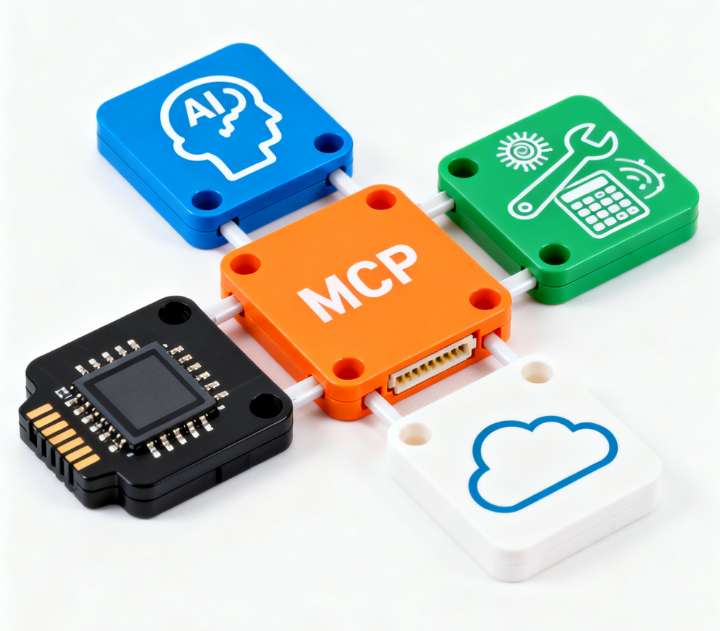
2. How Does an MCU Use the MCP Protocol?
Ai-Thinker's AiPi-PalChatV1 development board already provides UART-based MCP interaction. Developers only need to communicate with the AI module over the serial port to exchange data using the MCP protocol. For details, see Ai-Thinker's UART-MCP Protocol User Guide.